ALS is on the rise, tracking cases could tell us why
A growing number of states are requiring ALS reporting, which researchers say could lead to better treatments
(InvestigateTV) — Amyotrophic lateral sclerosis, or ALS, has no cure, and the number of cases is projected to rise. The number of people in the U.S. with the disease is not known because doctors are not required to report cases to their health departments. A growing number of states are making reporting mandatory.
ALS is also known as Lou Gehrig’s disease. It affects the nerve cells in the brain and spinal cord. It is considered a rare disease, and experts say there is no explanation for why the numbers are rising.
Living with ALS
In two years, ALS has taken Jennifer Robb’s ability to walk and to eat most solid food. It is now taking her ability to talk.
Using the text-to-speech tool, Jennifer told us it’s a “constant challenge” where “every day gets harder with loss of function.”
Her hands are her main source of communication, but Jennifer admitted they are getting weaker.
ALS destroys the nerve cells that control voluntary muscle movement. As motor neuron cells die, people lose the ability to walk, talk, swallow and breathe. There is no cure, and the disease is fatal.
Jennifer’s husband, Eric Robb, quit his job as a teacher to become her full-time caregiver. He said the disease is progressing quickly.
“Every month it seems like we have to change up our routine, we have to do things differently,” Eric said. Bedtime for the couple took about 30 minutes when Jennifer was first diagnosed. It now takes two hours to get her to bed and two hours to get her up.
“The disease doesn’t get better. It only gets worse, and that’s what’s tough about it. It’s painful to see somebody go through that because you know that she’s never going to get any of that back,” Eric said.
Research and treatment
Researchers across the country are working to change the course of the disease.
“We hope to put ourselves out of business. We don’t want to be doing this,” said Dr. Stephen Goutman, associate professor of neurology at the University of Michigan and director of its ALS clinic.
Goutman said he has seen people living with ALS for 14 years and has cared for more than a thousand people with the disease. He said the clinic follows close to 300 people at any given time.
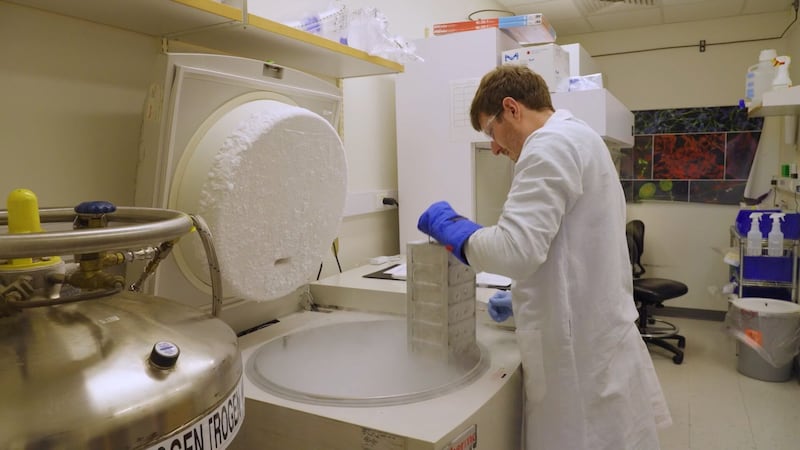
Goutman and Ben Murdock, an associate professor of neurology, of the University of Michigan Medical School have spent more than a decade researching the disease. Their work includes constant tests of patients’ blood. The average life expectancy after diagnosis is three years.
“These people are really scared, they’re really terrified by what’s going to happen to them, and it’s really heartbreaking, and so it’s incredibly important to, you know, give people hope or some options,” Murdock said.
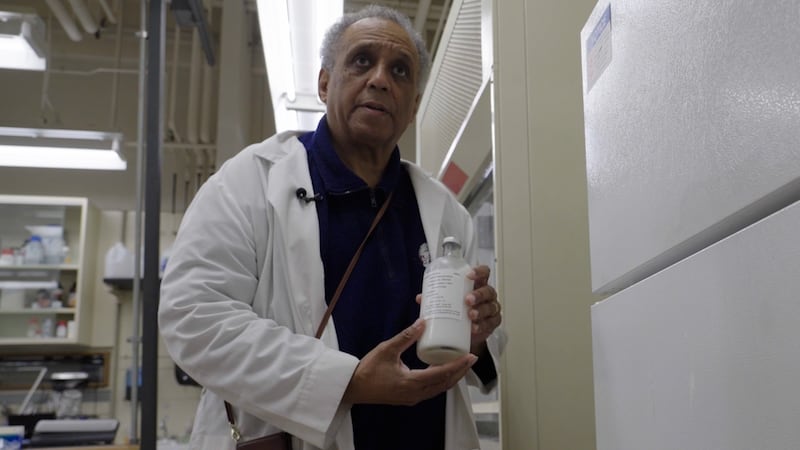
Murdock said only a handful of treatments exist for ALS. He said there hasn’t been much meaningful discovery in treatment since the drug Riluzole came on the market more than 30 years ago.
“That’s still the gold standard. It provides an extra, I want to say, two or three months of life,” Murdock said.
Murdock said he would like to see a treatment that provides at least six months to a year, but ultimately the end goal is a cure.
But a cure is much more complicated to find than a treatment, in part because no one knows why people get ALS, how to stop it or what causes it. Among experts, there are suspicions that pollutants in the environment play a role.
“Individuals exposed to metals seem to have this higher risk of ALS, and we don’t entirely know why that is, but it’s giving us something to dig into,” Goutman said.
Researchers said they could better study that if they knew where ALS patients were located.
State reporting requirements
ALS is not a mandated reportable disease. Most illnesses that must be reported to the Centers for Disease Control and Prevention are contagious. Only a few non-communicable diseases, such as cancer, are on the list.
A growing number of states have chosen to require reporting themselves. According to the ALS Association, they are Massachusetts, Vermont, Maine, California, Louisiana, New York, New Jersey and, as of 2025, Michigan.
More than a year after Michigan implemented its rule, the state had not collected a single case.
“We’re waiting on guidance from the health department,” Goutman said.
The Michigan health department declined interview requests. It said that once a pilot collection system is tested at the University of Michigan and is working properly, it will start collecting data statewide.
Goutman and Murdock advocated for the tracking. Murdock said the information will be helpful for studies of environmental exposure.
“Now we can kind of figure out where people have been living, where they come from, and hopefully we can start putting some of those puzzle pieces together,” Murdock said.
Cases are expected to rise nationwide. The projected number of cases in 2022 was nearly 33,000. The projected number for 2026 is 35,000.
Murdock said ALS is the most common rare disease. When asked if it is becoming more common, he said, “Yes, the rates have been going up.”
“The number of people that I care for in the 14 years that I’ve been here has almost doubled, and so there has to be a reason why,” Goutman said.
The rate of ALS is about 1 in every 100,000 people. Jennifer is the third person from her home county in Missouri to get ALS. The county has fewer than 40,000 people.
Missouri health leaders would not know that because it is not among the states tracking the disease.
“I think it needs to be mandated,” Eric Robb said. “People need to be aware of it. And the more they’re aware of it, the more funding there will be, the more help there will be for people with ALS.”
Jennifer told us she thinks the disease is being ignored. When asked if more people with ALS would be seen and the disease would be harder to ignore if reporting were mandated, she said yes.
She advocates for mandated reporting with ALS groups. She said she does not know how much time she has left.
“You have to have hope,” Jennifer said.
National registry and funding
A national ALS registry exists with the CDC. It relies on people self-reporting their disease. The CDC acknowledges it is missing cases because reporting is not mandatory. The CDC also says that even if reporting is mandated, it will rarely capture 100% of cases.
Advocates say more funding could help bring an end to ALS. In early 2026, Congress approved the highest level of funding ever for ALS, $315 million.
Funding for other diseases is in the billions: $8.1 billion for cancer, $3.9 billion for Alzheimer’s disease and $3.3 billion for HIV/AIDS.
The ALS Association says more funding will lead to more answers about ALS and hopefully lead to a cure.
Copyright 2026 Gray Media Group, Inc. All Rights Reserved.